Skip to content

Currently building Vedette + TalkToHudson.ai

I turn messy problems into things people actually use.

I build for the people in my life, at home and at work. Other people turned out to need it too.

I don’t start with technology. I start with a question that won’t leave me alone. Then I build the smallest useful version and improve it with the people actually using it.

Open to remote AI product, solutions engineering, forward deployed, and rapid prototyping roles.

  • AI product builder
  • Enterprise systems
  • Zero-to-one
01Featured work

Where should an organization actually use AI?

vedette-lilac.vercel.app
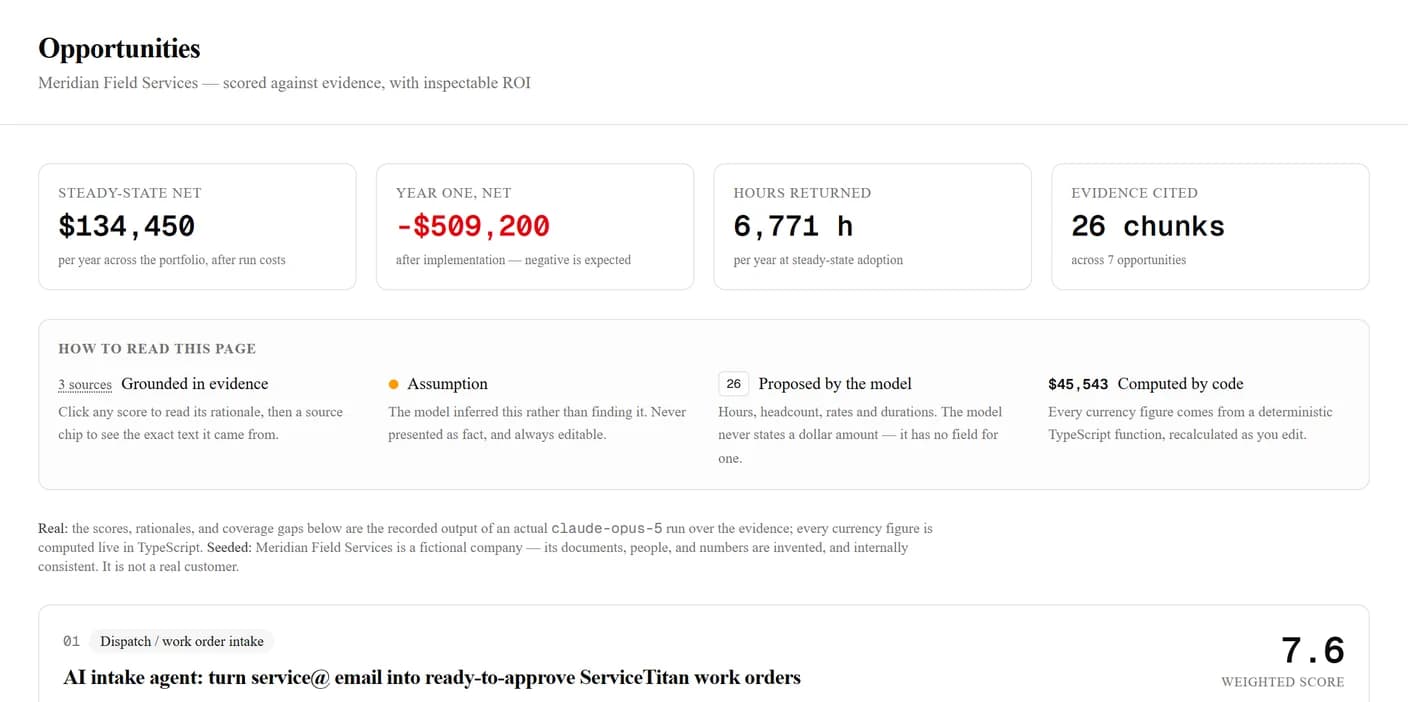
The Opportunities page in Vedette, headed Meridian Field Services, scored against evidence, with inspectable ROI. Four figures run across the top: steady-state net of $134,450, year one net of negative $509,200 in red, 6,771 hours returned, and 26 chunks of evidence cited. Below them, a panel explaining how to read the page, a note that Meridian is a fictional company, and the first ranked opportunity with a weighted score of 7.6.
AI opportunity assessmentFDE portfolio · Live

Vedette

I built Vedette to answer a question I kept running into: where should an organization actually use AI, and what evidence says it is worth doing?

I built it because I kept seeing the same problem. Organizations knew AI mattered, but figuring out where it would create real value was still surprisingly hard. So Vedette starts with the part I would want to trust before putting a recommendation in front of an executive: the evidence. It takes messy operational information, identifies AI opportunities, scores them against the available evidence, and makes the assumptions inspectable. The model proposes. Code calculates. Claims trace back to source material.

The interesting part for me wasn’t getting a model to generate recommendations. It was deciding what the model should be allowed to decide, what deterministic code should own, and how someone could inspect the reasoning instead of taking the output on faith. Meridian Field Services, the company in the demo, is fictional. I invented it so Vedette had realistic, messy enterprise data to work against.

  • Scores open to the source text behind them
  • Anything inferred is flagged as an assumption
  • The model proposes, TypeScript calculates
  • Default-deny RLS on all 18 tables
  • 39 tests, including the evidence contract
  • A real model run over fictional data
Built withNext.jsTypeScriptSupabaseVercel AI SDKZodClaudeVitestVercel

Live demo, no login. The opportunities and ROI slice is built. Later phases are labelled in the app rather than faked.
02Enterprise proof

I build like a startup inside a Fortune 500.

Twenty-six years inside a Fortune 500 taught me how enterprise constraints actually behave. Budgets, risk review, legacy systems, and people who have been burned by the last three tools.

26
Years improving how work actually gets done
2,000+
Sites in the environment I lead
100+
Reports, apps, and automations shipped to real users
20+
Executive dashboards in production

Gave people their time back

Recurring manual work taken off people’s plates for good, so those hours went to work that needed a person.

Turned “I’m not technical” into “I built that”

People who were certain they weren’t technical now design and run their own automations and agents.

  1. 01

    Find the real problem

  2. 02

    Build the smallest useful version

  3. 03

    Get it into users’ hands

  4. 04

    Learn from real feedback

  5. 05

    Improve and repeat

I learn by creating, not by theorizing.

Senior Lead Technology Business Systems Consultant · Fortune 500 financial services · 2022 to Present. Two earlier consultant roles at the same company, back to 2003.

Full resume
03Selected builds

Problems I couldn’t stop thinking about.

None of them started as a business idea.

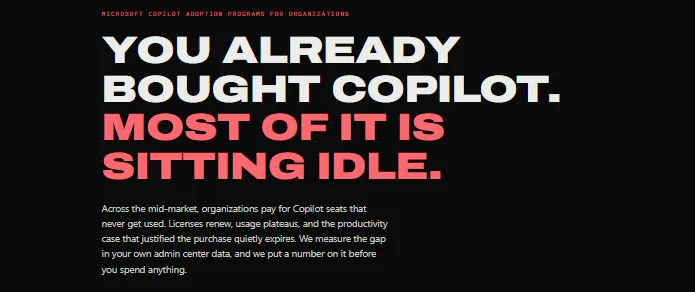
indispensablehq.com
The Indispensable home page. Above the headline, a line reading Microsoft Copilot adoption programs for organizations. The headline reads, you already bought Copilot, most of it is sitting idle, above a paragraph about organizations paying for Copilot seats that never get used.
AI adoptionEarly, testing in the real world

Indispensable

Organizations are buying AI faster than anyone is learning to use it. In every one I worked in I met the same person: excited about AI, no idea where to start, quietly sure they weren’t technical enough.

Copilot adoption programs, practical workflows, and a blueprint library, tested in the open with a community where people bring a real problem from their job and solve it.

Start from their calendar, not a feature tour
The blocker was almost never access. It was confidence.
Built to be outgrown
The name describes the person, not the product. Someone leaving because they no longer need it is the win.
talktohudson.ai
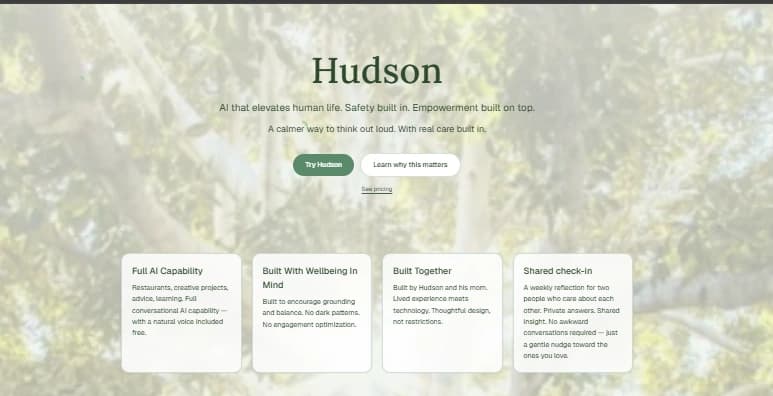
The TalkToHudson.ai home page. A calm, nature themed hero over a photograph of trees, with four cards describing full AI capability, wellbeing by design, building it together, and a shared check-in.
FlagshipLive in beta

TalkToHudson.ai

My oldest son Hudson loves the earth. He hikes, he gardens, he grows his own food. He also lives with schizophrenia. When he found AI I was hopeful, then I watched it turn into reassurance loops. He would delete the app, then reinstall it two days later.

A safety-first AI companion for him, and for the families who love someone like him. The first version took a long weekend. Every version since came from him texting me what wasn’t working.

A safety layer that can’t fail quietly
It runs on every conversation, and when it’s unsure it reaches for a person instead of guessing.
Designed against the grain
Everything underneath a product like this is tuned to produce one more message. Ending a conversation well means working against the defaults.
Built withNext.jsSupabaseVercelElevenLabsClaude CodeCursorGitHub
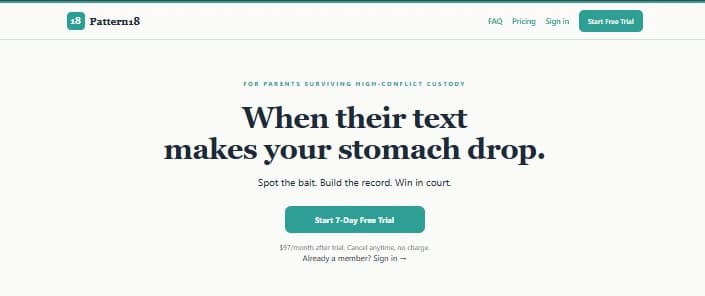
pattern18.com
The Pattern18 home page. The headline reads, when their text makes your stomach drop, above the line, spot the bait, build the record, win in court.
Family courtLive

Pattern18

I spent years trying to explain a complicated situation to people who needed it in order. Thousands of messages and no way to make them make sense. Writing it down was never the hard part. Seeing the pattern while living inside it was.

Evidence organization, pattern recognition, and timelines that make a complicated history understandable to an attorney, to a court, and to the person living it. Built in the open, with input from a growing community of parents that keeps changing what it does.

Not a replacement for an attorney
It’s built so people arrive organized, and attorneys spend their time practicing law instead of sorting through screenshots.
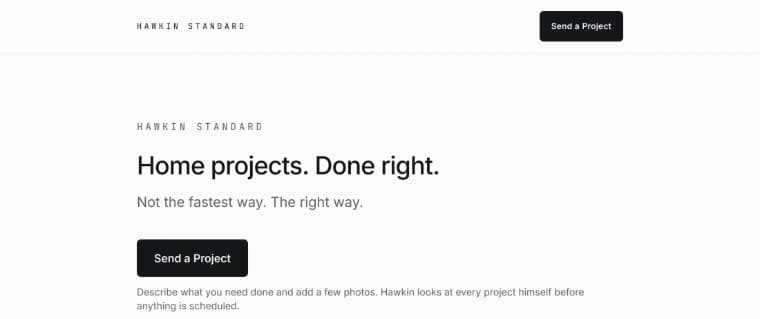
hawkinstandard.com
The Hawkin Standard home page. The headline reads, home projects, done right, above the line, not the fastest way, the right way. Below them a Send a Project button, and a note that you describe what you need done and add a few photos, and Hawkin looks at every project himself before anything is scheduled.
Operations automationLive, real customers

Hawkin Standard

My son started a handyman business and needed a way to take on work without living in his texts. Someone sends a project, sometimes with photos. He reviews it and sends back one price. Nothing gets scheduled or charged until they say yes.

I built the intake, the pricing workflow, and the customer communication around how he actually runs the business, not a generic booking form. It runs his real jobs today, for real customers.

One price, set before anything starts
No hourly rate, no price list. He looks at the actual project and sends back one number.
Built around how he works, not a template
The form, the pricing, and the follow-ups match his process. Nothing here is a stock scheduling tool with his name on it.
04The workbench

Questions that won’t leave me alone.

The products are my current answers. Two of these don’t have one yet, and those are the ones I think about most.

  1. How do you make an AI recommendation trustworthy enough to put in front of an executive?

    The recommendation is the easy part. What survives the room is whether anyone can tell which numbers a person chose and which ones a model guessed.

    Current answerVedette

  2. How do you make AI supportive without making it agreeable?

    Reassurance loops caused the harm I watched. But an AI that only validates is as useless as one that lectures. The answer is somewhere in telling the truth kindly.

    Still working on it

  3. Can a product be designed so people need it less over time?

    Everything I build is supposed to work this way, and I don’t think anyone has really solved it. Every incentive in software points the other direction.

    Still working on it

This list changes often. That’s usually a good sign. Last updated August 2026.

05About

Give me a messy problem, a blank page, and smart people to work with and I’m happy.

I’ve spent 26 years solving technology problems, and the part I’ve always loved is building. When someone I care about is struggling, my instinct is to build something that makes their day easier. I don’t ask what an app should do. I ask who it’s for. Technology has never been the goal.

I don’t walk in with an answer. I walk in with questions, because half the time the real fix isn’t AI, it’s fixing the mess AI would otherwise automate. Clean up the process first, then decide if a model even belongs in it. AI changes every few weeks. Committing hard, fast, to one tool or one answer is usually how you end up rebuilding the thing in six months anyway.

I’m also a boy mom, a founder, and a lifelong learner, happiest when something I made takes friction out of someone’s day.

I don’t optimize for engagement. I optimize for real life.

If my products do their job, people close the app and go live their lives. Success isn’t screen time. It’s people needing the software less.

Collegiate gymnastics
Progress is mostly repetition and small corrections. You fall, you adjust, you go again, and nobody claps for the reps.
Commercial fishing in Alaska
Slime line, set-net sites, gillnetting in Bristol Bay. The unglamorous work is still the work, and conditions never wait for your plan.
26 years building inside a Fortune 500
I know how real constraints behave. Budgets, politics, legacy systems. Ideas that ignore them don’t ship.

Learning nowClaude Code. I build with it every day. It has dramatically shortened the distance between having an idea and putting it in someone’s hands.

Gilbert, Arizona
06

A few things I believe

  • Build for one real person. Everyone else is a guess.
  • An AI that only agrees with you is more dangerous than one that’s wrong.
  • Ship before you’re ready, then stay and keep fixing it.
  • The person you’re building for should have your phone number.
  • Make useful things.
07Contact

Have a problem worth solving?

I’d love to hear about it.

I’m open to remote full-time roles with teams solving hard problems with AI.

Six questions, about two minutes. You get back the way I would think about it.

Would rather just email? christy@christybuilds.com